CCR: Singular Creative Reponse
How did your production skills develop throughout this project?
CCR: Singular Creative Reponse
How did your production skills develop throughout this project?
CCR Three Written Responses
1. How does your product use or challenge conventions and how does it represent social groups or issue?
Our film was centered around the game of chess which is normally very serious and has a professional tone or mood to it. To go against this expectation, we decided to make our film a comedy and bring humor to the game to deny audience expectations. In the film, we have two characters that visually oppose each other as one is dressed in a very professional manner while the other is seen in more casual clothing to create humor in the fairness and skill level of the match. The props we use in addition to the natural environment we set up in added to the ridiculousness of the match as a character seems to be in a very intense situation with black face paint and a bandana over a game of chess with calm surroundings. Comedies are known for being over the top and use of props to shows that. However, comedies also have dialogue that allow for wordplay or verbal jokes to be said but our film had no audio besides music to evoke laughter in the viewer. Our film sets up expectations from the beginning that are completely denied by the end. One player is dressed very professionally and the other is way more casual and shown to not know how to play properly. One would assume to more professional player wins but instead the female player does. This is representative of women empowerment in specifically male dominated spaces as the male opponent is the one wearing normal chess attire and feeling comfortable until the female opponent expresses her true self and her real abilities.
2. How does your project engage with audiences and how would it be distributed as a real media text?
My project engages with audiences through its narrative, editing, mise en scene, and sound. The whole purpose of the film was to be as exaggerative and ridiculous as you could possibly get in a chess game. Therefore, we built a story that was full of surprises and dramatic scenes that felt unrealistic and comedic that would make the audience laugh. the props and setting also add to this unrealistic feeling that is present in some of the scenes which creates disbelief and confusion for the viewer to add to the chaos of the film. The music also completely shifts in tone which makes the viewer aware of the shift in power dynamic of the movie while also adding humor as it goes form more classical sounding music to something very heavy which is very unexpected. Black out transitions show a disconnect between scenes and how they are not right after each other but instead some time apart. Shots were slowed down to add emphasis to chess pieces movements to make them overly dramatic and instill laughter. Our film can be distributed one way through the use of online video sharing websites such as YouTube in order to get the film out into the public where it can be seen by as many people as possible. Another possible method of distribution is the use of film festivals such as the LA Comedy Film Festival where the main focus is on comedy with specific categories for films under 10 minutes. It is also located in an area where film is a big focus and most key figure in the movie industry can be found.
3. How did you integrate technologies - software, hardware, and online - in this project?
In the process of creating the film, we used a variety of different technologies. To begin, in order to film the movie, we used an iPhone 14 due to the superior camera quality it had compared to the other available cameras. We also had access to a tripod that allowed us to set up different types of shot that we used in the film. We were able to film aerial shots with the use of the tripod as well as close ups of the chess board. these shots would have come out to be shakier and worse quality if we didn't have the tripod to help stabilize the shots. I became very familiar with the software we used to create this project. As the editor, I heavily used adobe premiere rush. We used to program to both shoot and edit the film. It had more features that we could use with filming than the base phone as well as better focus features. Then the footage was given to me where I went in and trimmed the shots down, added transitions, and put them in their correct order. It allowed me to add text to the project and change the speed of the shots to get desired effects. Finally, it was used to manipulate the sound of the film in order to add music and take out unwanted background noises form the film.
Adding Text and Messing with Speed
When I first saw the editing software I was going to use, I made note of the fact that there was a way to put text onto the screen and also change the speed of the shots you put in. When I first saw these, I didn't think much of them and thought of them as just fun extras that you could use. I initially didn't see a real application they had besides having fun with a shot or bringing up your title/credits.
I had three shots in our film where the plan was to have slow-motion. Other than that, I didn't think I would have to mess around with the speed feature. When slowing down these shots, you could really see the power of the 1st opponent which was exactly what we were trying to pull off. However, once I was done with the main editing and needed to reduce the film to one minute, I saw myself almost abusing the feature in order to get it into the correct time limit. Looking through the speed up film I wasn't really happy with how it looked as some shots were hindered from the speed up. Other shots showed little difference when they were sped up which benefitted in condensing the film's runtime.
Shots where a slow motion effect was applied
The it came time to add a title and credits. My first title was a more sophisticated looking font with thin lettering. I believed it matched the beginning portion of the film better than other possible choices. Going through the sections though made me realize that some options just fit the film better than others which I hadn't really considered before working on the text portion. It made me more careful when choosing the font for out credits and made me realize that this font should be more professional looking to reflect the people behind the film.
After a screening of out film, I was made aware of the title not matching the overall vibe or feel of them film and that it could be changed. It made me further reflect on how these small features impacted the overall film.

After discussion in class and playing with these features myself, I saw how the use of text and speed features were something to really focus on for the feature as they were not just small addons to use when editing. They were core components that could completely change how others perceive your film. The original title felt fragile which was not an aspect that could be found within the film. It's important to have your text reflect the thing it says. The title should be formatted in a way to hint to the viewer the type of movie their watching and credits in a way to show the traits of the people that worked behind the film. Speed changes can shift the mood completely of a shot. Slowing downs shots can create an intense feeling that you are looking for while speeding up can make something more humorous or cut down on the role a specific shot plays in the film.
Getting the Film to One Minute
A key aspect to this film was that it had to be one minute with a beginning, middle, and ending. As the editor, I had to make sure a clear story was told using the shots we took that lasted only a minute. I initially believed this was going to be a simple process as we had a clear story set up that I believed wouldn't take that long.
This proved untrue once I got done editing the first rough edit of our film with footage form only the first two shooting days and it ended up being around 5 whole minutes long. I was initially concerned but knew there was still much to be done so I didn't worry too much about it being too long. I still had to trim down some shots and finish deciding some of the takes still.

I then added the footage we got on the third day of shooting which thankfully wasn't as much as the previous days. Once I was finally able to cut it all down with including all our shots, it was still four whole minutes long. I met with my group and got feedback and want I could still trim out. I was able to, but it still was about 3 minutes in length.
I decided I would just have to get rid of some of the shots we took for the film so that I could get it to only a minute. I felt unsure about it as I was essentially taking away work that we had done but my group understood that it had to be done and were okay with it. I saw that some shots felt too repetitive and were unnecessary in getting across the intended feeling. We had chess shots of the same move being done that also just added time without adding substance. Doing this, as well as using some effect, helped me get the film down to the proper time limit.

This experience taught me what is important to include in a film. Just because you filmed something doesn't mean you have to include it. It can just make your final product ultimately worse even if you feel as though your "wasting" the shot. What's important is that you include the shots that overall add to your final product in a meaningful way that can't be found in some other shot. For example, we had a close up shot of a chess piece slamming into another and an aerial shot of the same thing. However, the aerial shot just wasn't as impactful and hard-hitting as the close up and so it wasn't needed and just added unnecessary perspective. However, setting up the shot took more effort than others and it would feel like a shame to let it go to waste. But if it hinders the film then it's something that should be edited out. Some of your hard work is going to get cut out in order to meet specific demands and that's okay.
Adding Transitions to the Film
After cutting down all of the shots we had it was time to add transitions. I didn't think much of this part initially as I saw as just a small aspect of editing a film together. I believed it was like a PowerPoint where it just gets you from one place to another.
The process was pretty simple as all I had to do was go the shots I trimmed and apply a transition to them. Then once I started, I saw it played a much larger component than I thought.

By itself, the film seemed awkward at some points where scenes follow each other but do so in an unsatisfying way. Giving these shots transitions that aren't straight cuts makes them flow way better in the film and makes the film feel less static as well. This was extra beneficial as the film had lots going on and making that feel boring or rushed would have detracted from the work we put in.
It also acted as a way to show time progression through the use of black outs to take viewers away from one shot and put them into another so that they can assume it isn't straight afterwards. Using fades, I was able to stack some facial expressions unit the next one fully came in to show a parallel in the characters and how the first opponent was now like the second.
During this process, I became aware of the importance of transitions in storytelling and a film's composition. Transitions weren't just the middle step in moving from shot to shot but instead the key component on how your film is told and perceived by the viewer. You can express how long an event took place to give a viewer a clearer idea of where they are at within the story or express changes within the story without having to change the setting or have dialogue. They also have the ability to break apart patterns within your film and stop your film from feeling stiff or stale which may happen when just using straight cuts or a lack of transitions. It makes the film more digestible for a viewer by making it easier to understand and look at. They fill in the voids between your shots that may seem disconnected when just played right after each other and add context to events like personality changes and shifts in time.
The Importance of an Editor's Log
As part of the production portfolio for our film, I have to turn in what is called an editor's log. This is a document that essentially tracks what you did during all of your editing sessions.
At first, I saw this as just extra work that I had to do on top of having to actually edit the film. I thought it was unnecessary and would ultimately take away from the film. In fact, I thought it was so unnecessary that I remembered I had to do it halfway through my first editing session. After the first session I felt as though it was wasting time just writing down what I already knew. However, after one to two more session I changed my view.
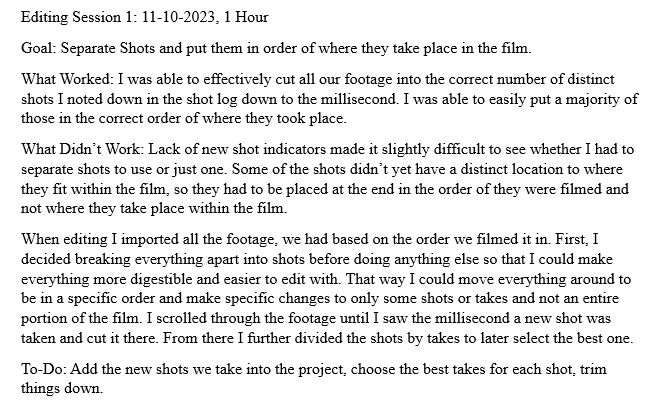
When I wrote out my thoughts about the session for things like why certain editing decisions were made, it helped reaffirm why I did what I did. Not only that but it allowed me to look back on my previous thought process to see if it was applicable to a different situation or if maybe that wasn't the best decision to make at the time and I should go and fix it.
It also allowed me to say the wrong these that happened and include possible solutions. Most of which involved group discussion which most likely would have not come straight to mind if I didn't have to actually write it out and think about what I could do.

Conversation between me and director on how to shorten film
Most importantly it kept me organized. I could easily look back on what I worked on previously and see what I planned to work on for next time. Editing was not a daily process so not having written down my next goals would make it harder for me to remember what I was supposed to working on.
After working on the editor's log, I realized it's grand importance to the editing process overall. It wasn't extra work that was assigned but a document that would allow me to make the editing process easier. It allowed me to rationalize my decisions for certain editing choices and reflect if I did something for the right reason or if there was another way to go about things. The document also gave me ideas for next editing session as I could see what I had completed so far and what I had left, as well as the things that went right when editing that I could keep in mind for next time. Lastly it proved helpful as it forced me to see what I can do different or better for next time as I needed to write the issues I encountered and ways to fix them which ended up working most of the time.


